
Excavation: Everything You Need To Know
- mrvicdemolition
- Sep 3, 2025
- 4 min read
Did you know that excavation is a fundamental step in the completion of many construction and renovation projects? Whether it's repairing a house foundation, installing a drain, or carrying out other major work, it often constitutes the first phase of operations. Whether you're working on rocky, sloping, or unstable ground, each situation presents its own challenges.
This is why it is essential to entrust this task to a specialized service who are expert in Excavation site in Pascoe Vale. Also they are the masters the appropriate techniques and complies with current regulations.
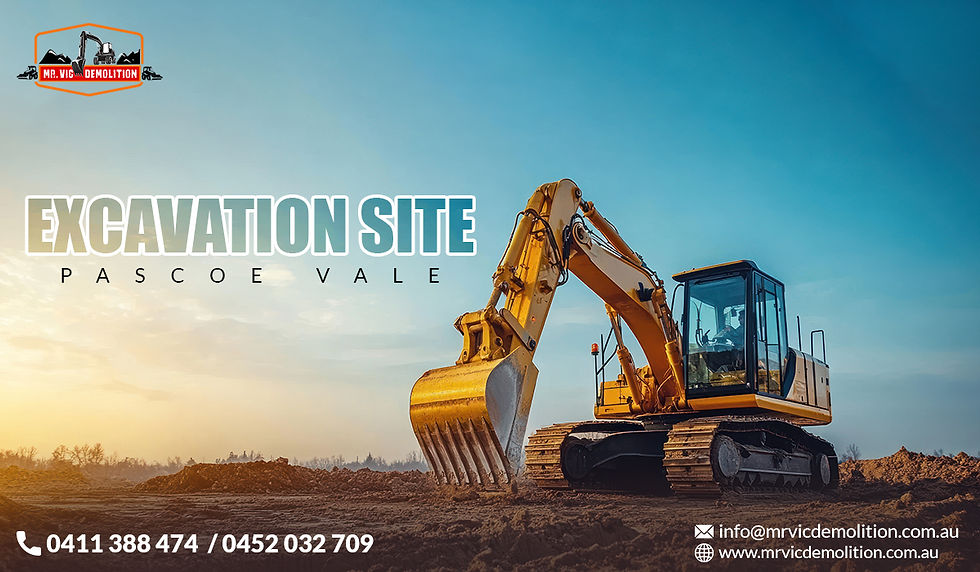
But what exactly does this operation consist of? What are the different types of excavations? Who should you call to carry out your excavation work?
Here is a complete guide to excavation that will provide you with the essential information to better understand this process and help you make the right choices for your projects.
What is excavation ?
Excavation is an operation that involves digging into the ground to carry out various construction, repair, demolition or infrastructure development projects. Depending on the objective of the work, the scale of the project, the nature of the soil, the topography of the land and the depth of the water table, it can take several forms and require the use of suitable methods.
How to manage excavation in complex conditions?
[1] Identify the characteristics of the terrain
Before beginning any excavation project, it is essential to fully understand the nature of the terrain. A thorough geotechnical study is often necessary to identify soil characteristics, assess the risk of landslides, and detect the presence of massive rocks. This analysis also determines the necessary equipment and the most appropriate techniques. For example, for rocky terrain, it is useful to conduct surveys with a geologist to identify potential faults or fracture zones. On sloping terrain, it is essential to analyze the overall stability and plan measures to control erosion. Finally, on unstable terrain, the geotechnical study will help recommend preliminary consolidation work.
[2] Strategies for Rocky Terrain
For terrains composed primarily of rock, specialized solutions are required. The use of explosive materials or hydraulic hammers is often recommended to efficiently break up massive rocks. Excavators equipped with hydraulic breakers also allow for fast and precise work. Once the rocks have been excavated, the debris can be recycled into usable materials for the project, such as backfill or decorations. This approach not only reduces waste but also limits the costs associated with purchasing new materials.
[3] Techniques for sloping terrain
Excavating on sloping ground requires careful planning and appropriate techniques. An effective strategy is to create terraces, i.e., intermediate levels that stabilize the ground and facilitate work. These terraces serve to distribute loads and limit the risk of landslides. Furthermore, the installation of retaining walls is essential to protect the site from potential landslides. Finally, proper water management is crucial. Drains and other drainage systems should be installed to reduce erosion caused by the weather.
[4] Managing unstable terrain
Unstable terrain presents significant challenges in terms of safety and viability. These processes increase the stability of the terrain and prevent collapses. The use of temporary platforms, such as scaffolding or stabilized structures, also ensures worker safety during construction. Finally, progressive excavation, carried out in small sections, minimizes the risk of collapse and ensures better control over operations.
The stages of an excavation project
[1] Location of underground infrastructure
Before undertaking any excavation work, it is crucial to identify the risks to avoid any danger, damage or inconvenience. In this situation, the excavation professionals will be able to precisely identify the location of gas pipes, electrical wires, and other buried installations.
[2] Site preparation
After locating the underground infrastructure, the excavation company will clear the area to ensure safe access. If necessary, it will therefore move outdoor furniture, terraces, fences and any other furniture or obstacle likely to hinder the operation.
[3] Securing the construction site
To ensure the safety of workers, agents and even passers-by, it is essential to put in place appropriate protective measures, such as:
✦ Installation of safety barriers
✦ The installation of signs indicating regulatory distances
✦ Adding safety rails
✦ Provision of temporary access to the property
✦ Any other necessary preventive measures
[4] Digging
Once the area is secured, the excavation phase can begin. The type of excavation will be determined based on the project's needs.
[5] Completion of the required work
Once the digging is complete, the work for which the excavation was carried out can begin. Laying the drain, repairing cracks, earthworks, replacing or creating new foundations- it is at this stage that the professionals come into action to bring the project to fruition.
[6] Backfilling and finishing
Once the work is completed, it is time to move on to the finishing and site cleaning stage.
Conclusion
Excavation is a complex and delicate operation that requires technical skills and suitable equipment. It is a key step in the completion of many construction and renovation projects. Calling on soil removal services Moorabbin from Demolition and excavation guarantees you long-lasting work, carried out safely and in compliance with current standards. From the start of your demolition project, our team will help you devise a suitable plan suiting on your specific requests and requirements.
For more details, get in touch with us !
◈◆◈◆◈◆◈◆◈


Comments